Diamond vs. Cubic Zirconia: Everything You Need to Know
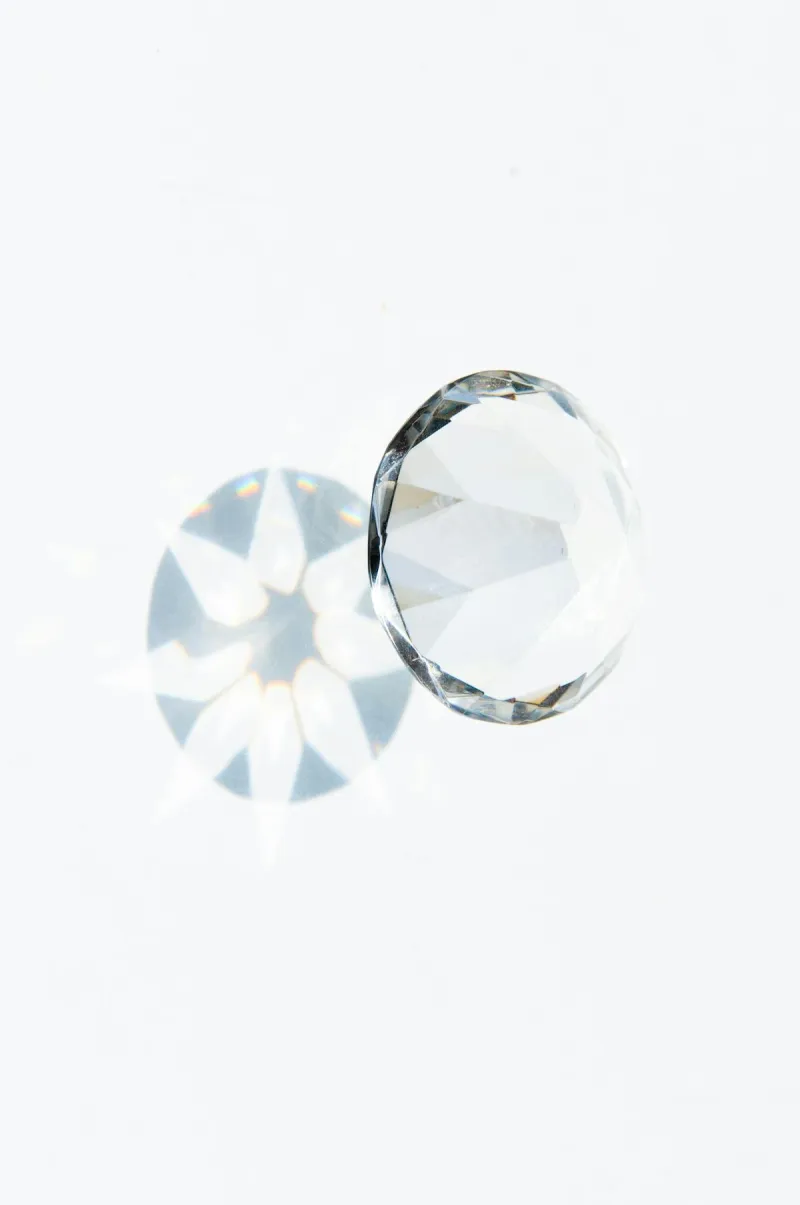
Cubic zirconia (CZ) is the most widely used diamond simulant in the world. At first glance, a high-quality CZ can look remarkably similar to a diamond, which makes it an attractive option for costume jewellery and travel pieces. However, the similarities are largely superficial. Diamond and cubic zirconia differ in virtually every measurable property, from hardness and optical behaviour to longevity and value retention. This guide provides a thorough comparison so you can understand exactly what you are choosing between.
What Is Cubic Zirconia?
Cubic zirconia is the cubic crystalline form of zirconium dioxide (ZrO2). It is entirely lab-created and has been mass-produced as a diamond simulant since the late 1970s. CZ should not be confused with the natural mineral zircon, which is a completely different substance (zirconium silicate). CZ was developed specifically to resemble diamond at a low cost.
Key Differences at a Glance
| Property | Diamond | Cubic Zirconia |
|---|---|---|
| Chemical composition | Carbon (C) | Zirconium dioxide (ZrO2) |
| Hardness (Mohs) | 10 | 8.0-8.5 |
| Refractive index | 2.417 | 2.15-2.18 |
| Dispersion | 0.044 | 0.058-0.066 |
| Density | 3.52 g/cm³ | 5.6-6.0 g/cm³ (much heavier) |
| Thermal conductivity | Very high | Low |
| Durability over years | Permanent brilliance | Scratches, clouds, and dulls over time |
| Price (1-carat equivalent) | 2,000-15,000+ pounds | 1-20 pounds |
Hardness and Durability
This is the most significant practical difference between diamond and CZ. Diamond ranks 10 on the Mohs hardness scale, while CZ ranks 8.0 to 8.5. While 8.5 sounds close to 10, the Mohs scale is not linear. Diamond is many times harder than CZ in absolute terms.
In daily wear, this difference has real consequences:
- Scratching: CZ will develop surface scratches from contact with everyday materials like dust (which contains quartz at Mohs 7). Over months of wear, these micro-scratches accumulate and dull the stone's surface. Diamond remains scratch-free indefinitely.
- Clouding: CZ can develop a cloudy or hazy appearance over time as surface abrasion reduces light transmission. Diamond never clouds.
- Edge wear: The facet edges of a CZ gradually soften and round, losing the crisp geometry that defines good light performance. Diamond's facet edges remain sharp forever.
Practical Lifespan
A CZ stone worn daily in a ring will typically begin to show visible wear within six months to two years, depending on the wearer's activity level and how well the stone is maintained. A diamond will look the same in a hundred years as the day it was cut. For engagement rings and other daily-wear jewellery, this durability difference is critical.
Optical Properties
Diamond and CZ sparkle differently. Diamond has a higher refractive index (2.417 vs. 2.15-2.18), which means it bends light more sharply and produces superior brilliance, the total amount of white light returned to the viewer. CZ has higher dispersion (0.058-0.066 vs. 0.044), meaning it splits light into more colourful rainbow flashes.
The result is that CZ can look overly "flashy" or "rainbow-y" compared to diamond, especially in larger sizes. Experienced eyes can spot a CZ by its excessive fire and slightly lower brilliance. When new and well-polished, a small CZ can be convincing, but the optical differences become more apparent in stones over 0.50 carats.
Weight Difference
CZ is significantly denser than diamond, about 1.7 times heavier. This means a CZ that is the same physical size as a one-carat diamond will weigh approximately 1.7 carats. For this reason, CZ is typically sold by millimetre size rather than carat weight. This weight difference is also a useful identification method: a CZ stone feels noticeably heavier than a diamond of the same dimensions.
Colour and Clarity
Because CZ is manufactured, it can be produced with virtually no inclusions and in any colour. Most CZ used as a diamond simulant is produced colourless, equivalent to D colour on the diamond scale. While this sounds ideal, it can actually be a tell: a flawless, perfectly colourless stone at a very low price is almost certainly not a diamond, since such high-quality natural diamonds are extremely rare and expensive.
Price Comparison
The price difference is enormous. A quality CZ costs just a few pounds per stone, while diamonds range from thousands to tens of thousands. This makes CZ ideal for fashion jewellery, travel replacements, and situations where the cost of loss or damage would be unacceptable with a diamond.
However, the extremely low cost of CZ also means it has zero resale value, and replacing worn stones every year or two means recurring costs that add up over time. If durability and lasting value matter, lab-grown diamonds or moissanite offer much better middle-ground options.
When CZ Makes Sense
- Fashion and costume jewellery: CZ provides sparkle for trend-driven pieces that may not be worn long-term.
- Travel jewellery: Wearing a CZ replica while travelling protects your real diamond from loss or theft.
- Temporary placeholder: Some couples use a CZ ring temporarily while saving for a diamond engagement ring.
- Testing styles: CZ is inexpensive enough to try different shapes and settings before committing to a diamond.
- Children's jewellery: The low cost makes loss or damage less concerning.
When Diamond Is the Better Choice
- Engagement rings: The hardness, durability, and lasting beauty of diamond (natural or lab-grown) make it far more suitable for a ring worn every day for decades.
- Heirloom pieces: Diamonds endure for generations without losing their appearance.
- Any daily-wear jewellery: If you will wear it regularly, the scratch resistance of diamond is worth the investment.
- When value retention matters: Natural diamonds retain some resale value; CZ has none.
How to Tell Diamond and CZ Apart
- Thermal test: Diamond conducts heat rapidly, while CZ does not. A standard diamond tester will easily distinguish them.
- Weight test: CZ is about 1.7 times heavier than diamond for the same size.
- Sparkle pattern: CZ shows more colourful rainbow flashes and less white brilliance compared to diamond.
- Fog test: Breathe on both stones. Diamond disperses moisture almost instantly due to its thermal conductivity. CZ stays foggy for a few seconds.
- Wear inspection: After several months of wear, CZ will show surface scratches visible under magnification. Diamond will not.
Frequently Asked Questions
Is cubic zirconia a real gemstone?
CZ is a real crystalline material, but it is not a natural gemstone. It is entirely lab-created and classified as a diamond simulant, meaning it is designed to imitate the appearance of diamond without sharing its chemical composition or durability.
How long does cubic zirconia last?
A CZ stone will begin to show visible wear (scratches, dulling, clouding) within six months to two years of regular daily wear. For occasional wear, it can last much longer. It will never match diamond's permanent brilliance.
Can a jeweller tell the difference between CZ and diamond?
Yes, easily. A simple thermal conductivity test, which takes seconds, reliably distinguishes diamond from CZ. Visual inspection by an experienced gemologist can also identify CZ by its dispersion pattern, weight, and surface wear.
Is moissanite better than cubic zirconia?
For jewellery intended for regular wear, moissanite is significantly better. It is much harder (9.25 vs. 8.0-8.5), does not scratch or cloud over time, and has superior optical properties. CZ is only preferable when cost is the overriding concern.