Sapphire vs Topaz: Which Blue Gemstone Is Right for You?
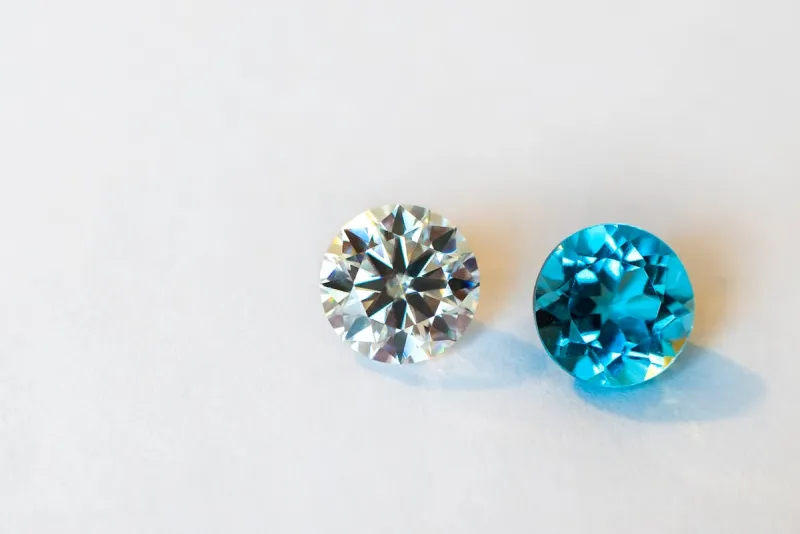
Sapphire and topaz are two of the most popular blue gemstones, and their visual similarity often leads buyers to compare them side by side. However, these stones differ dramatically in composition, durability, rarity, and price. This guide breaks down every key difference to help you choose the right blue stone for your jewellery needs.
At a Glance Comparison
| Property | Sapphire | Blue Topaz |
|---|---|---|
| Mineral | Corundum (Al2O3) | Topaz (Al2SiO4(F,OH)2) |
| Mohs Hardness | 9 | 8 |
| Cleavage | None (parting only) | Perfect basal cleavage |
| Refractive Index | 1.762 – 1.770 | 1.619 – 1.627 |
| Treatment | Often heat-treated | Nearly always irradiated + heated |
| Natural Colour | Naturally blue | Naturally colourless (blue is produced by treatment) |
| Price (per ct) | $200 – $50,000+ | $3 – $25 |
| Birthstone | September | November (also December for blue) |
Colour Comparison
Both sapphire and blue topaz can display beautiful blue hues, but the character of the colour differs meaningfully:
- Sapphire – Displays a deeper, more velvety blue with greater colour complexity. Fine sapphires show subtle shifts between blue and violet hues as the stone moves in the light. The colour appears rich and dimensional.
- Blue topaz – Tends to show a cleaner, more uniform blue without the depth and complexity of sapphire. Sky blue topaz is pale and gentle; Swiss blue is bright and cheerful; London blue is deep and slightly greyish. The colour, while attractive, can appear more one-dimensional compared to fine sapphire.
Hardness and Durability
Sapphire rates 9 on the Mohs scale, making it the most durable coloured gemstone available, second only to diamond. It has no true cleavage, which makes it exceptionally resistant to chipping and breaking. This makes sapphire ideal for engagement rings and everyday jewellery.
Topaz, at hardness 8, is still quite hard but has a critical weakness: perfect basal cleavage. This means it can split cleanly along a flat plane if struck with sufficient force at the right angle. While this does not make topaz fragile in normal use, it does mean the stone requires more careful handling than sapphire, particularly in ring settings.
Rarity and Origin of Colour
Sapphire is naturally blue, with its colour arising from trace amounts of iron and titanium within the corundum crystal structure. While many sapphires are heat-treated to improve their colour, the starting material is inherently blue.
Blue topaz, in contrast, is almost never naturally blue. The vast majority of blue topaz starts as colourless topaz that is irradiated and then heated to produce the blue colour. This means that while the stone itself is natural, its blue colour is entirely the result of human intervention. This distinction matters to buyers who value natural colour.
Pricing
The price gap between sapphire and blue topaz is dramatic. A fine blue sapphire can cost thousands to tens of thousands of dollars per carat, while blue topaz typically costs between $3 and $25 per carat. This makes blue topaz one of the most affordable coloured gemstones available and an accessible option for buyers who love blue but have a limited budget.
However, it is important to compare like with like. Imperial topaz (the natural golden-orange variety) is significantly more expensive than blue topaz and can approach the lower range of sapphire pricing. The comparison here is specifically between blue sapphire and treated blue topaz.
Suitability for Jewellery
Engagement Rings
Sapphire is one of the best gemstones for engagement rings, offering exceptional hardness and durability for daily wear. Blue topaz can be used in engagement rings but is a riskier choice due to its cleavage. If choosing topaz for a ring, opt for a protective bezel setting.
Earrings and Pendants
Both stones work beautifully in earrings and pendants, where they receive less physical stress. Blue topaz's affordability makes it particularly popular for larger earring and pendant designs.
Metal Pairings
Both blue sapphire and blue topaz pair naturally with white metals like white gold, platinum, and silver. The cooler tones of white metals enhance the blue colour of both stones. Yellow gold can also work, creating a classic, warm contrast with the blue.
When to Choose Sapphire
- You want maximum durability for daily wear, especially for rings
- You value naturally coloured gemstones
- You are buying a significant piece of fine jewellery or an engagement ring
- You want a stone that holds and increases in value over time
- You appreciate colour complexity and depth
When to Choose Blue Topaz
- You want an attractive blue gemstone at a very affordable price
- You are buying fashion jewellery, earrings, or pendants
- You want a larger stone without a large budget
- You are buying gift jewellery for casual occasions
- You prioritise size and visual impact over rarity
Frequently Asked Questions
Can blue topaz pass as sapphire?
To an untrained eye, blue topaz can resemble sapphire, but gemmologists can easily distinguish them using a refractometer or loupe. The stones have different refractive indices, specific gravities, and optical characteristics.
Is blue topaz a good alternative to sapphire?
Blue topaz is an excellent visual alternative to sapphire for buyers on a budget, particularly for earrings and pendants. However, it cannot match sapphire's durability, colour depth, or prestige.
Why is sapphire so much more expensive than topaz?
Sapphire is rarer, naturally coloured, harder, and more durable than treated blue topaz. It also has a long history of prestige and desirability. Blue topaz is abundant and its colour is artificially produced, keeping prices low.
Which is better for an engagement ring?
Sapphire is significantly better for engagement rings due to its superior hardness (9 vs 8) and lack of cleavage. Sapphire can withstand decades of daily wear without issue. See our buying guides for engagement ring advice.